Keep EU product compliance from delaying your launch
Normio connects EU standards, risk assessment, validation, and your technical file in one workflow.
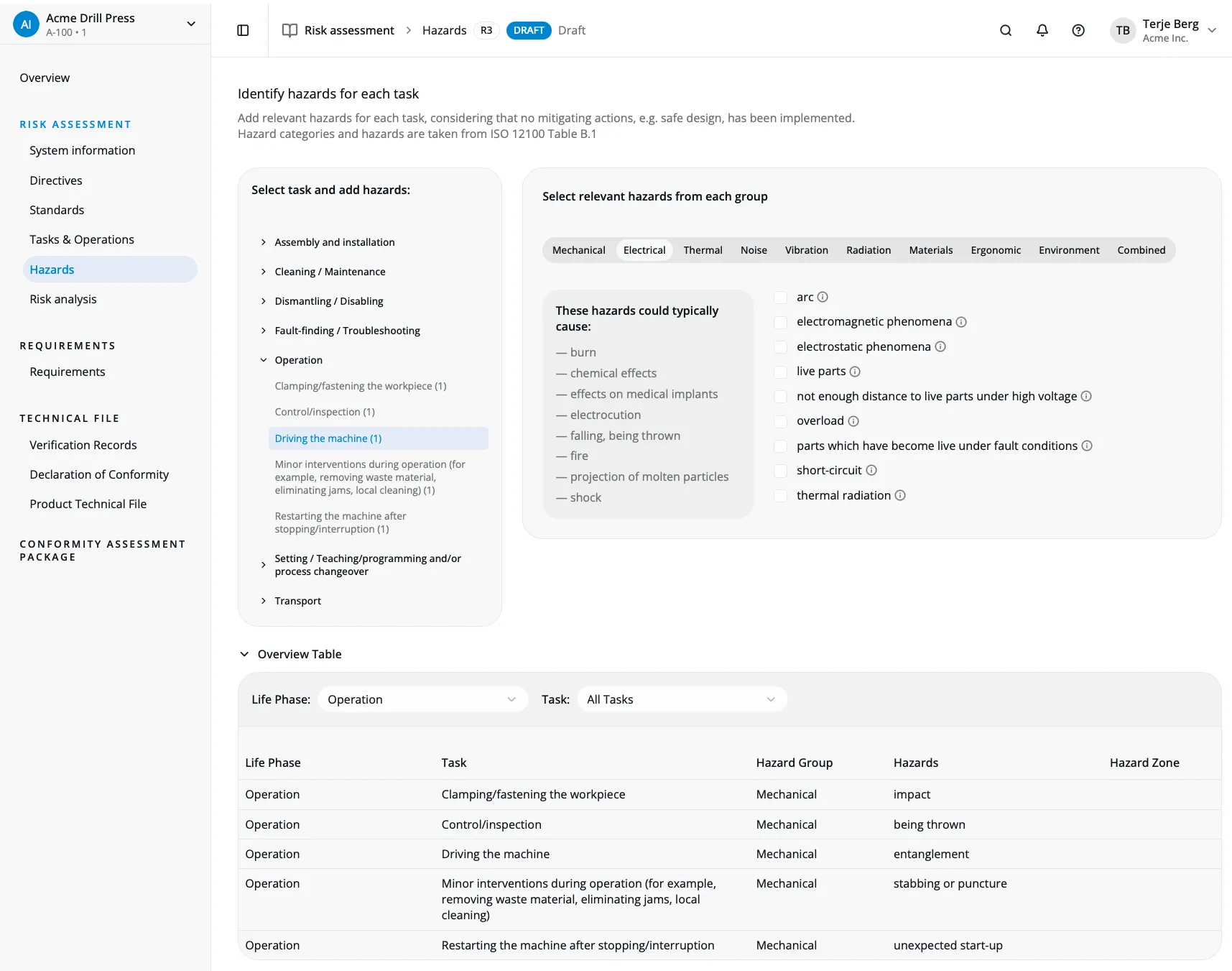
Fully connected workflow from regulatory identification to Declaration of Conformity
Capture hazards, decisions, and measures in one place, then link them straight to validation and evidence.
Link risk-reducing measures to validation work and traceable evidence instead of losing them in documents and spreadsheets.
Identify the right directives and standards earlier with our extensive library before gaps show up and delay launch.
By the time testing fails, the real problem started months earlier
In many product companies, compliance is spread across product, engineering, and outside consultants without deep product expertise. The consequences show up later as failed testing, redesign, launch delays and avoidable legal exposure.
The ugly reality: teams often know they are not fully following legal requirements, but continue because "that's how we did it last time".
Standards are selected too late
Teams enter design and test before confirming which directives and harmonized standards apply.
Risk actions go stale
Risk assessments happen, but actions rarely become owned requirements and planned validation.
Evidence gets scattered
Plans, test evidence, and technical-file inputs end up split across docs, folders, and email.
Problems surface at the worst time
Late gaps trigger failed tests, redesign loops, launch delays, and avoidable legal exposure.
Standards are selected too late
Teams enter design and test before confirming which directives and harmonized standards apply.
Risk actions go stale
Risk assessments happen, but actions rarely become owned requirements and planned validation.
Evidence gets scattered
Plans, test evidence, and technical-file inputs end up split across docs, folders, and email.
Problems surface at the worst time
Late gaps trigger failed tests, redesign loops, launch delays, and avoidable legal exposure.
Compliance is not a final check — it is part of product development
The companies that avoid late-stage surprises are not the ones spending the most on certification. They are the ones managing compliance as an active workflow throughout development.
Old model
Treat compliance as something to check at the end, outsource, or hand over to one specialist.
Workflow-first model
Make requirements, risk, validation, and documentation part of how the product team works throughout development.
"We can sort compliance out when we perform testing"
If standards, risk actions, and validation scope were not made clear earlier, the lab simply exposes problems that already exist.
From standards to technical file, every step must connect
Teams need traceability from selecting standards and performing risk analysis through validation, declaration of conformity, and technical documentation.
Define product context
Describe your product, users, environment, and intended use to set the scope for regulatory analysis.
Select legislation and standards
Start with the directives and standards that define what your product needs to meet.
Not defining the right standards needed to fulfil legislation
Run a valid risk assessment
Capture hazards, hazardous situations, events, harms, and risk-reducing measures in a structured way.
Not performing a risk assessment that meets legislative requirements
Turn outputs into managed requirements
Risk-reducing measures and normative requirements need to become concrete actions that can be validated.
Validate and collect evidence
Prove that requirements were met with tests, records, and linked evidence — not just assumptions.
Not proving with traceability that all requirements were met
Compile the technical file
Build the documentation package as the work progresses, instead of scrambling at the end.
Normio gives your team one place to manage the conformity workflow
Find standards, run risk assessment, turn outputs into requirements, track validation, and compile technical documentation in one structured workflow.
Identify the right directives and standards before engineering commits to the wrong path.
Capture hazards, measures, and traceability in one structured flow.
Turn compliance outputs into owned requirements, validation tasks, and evidence.
Keep declarations and file-ready documentation organized throughout development.
Show what is complete, what is blocked, and where compliance risk still sits.
Understand the compliance work before it becomes a launch problem
Field guides for machinery and hardware teams turning EU rules, risk assessment, validation, and technical documentation into manageable product work.
EU Conformity Assessment for Machinery and Hardware Products
Do we actually have EU conformity assessment under control early enough?
Product and engineering leads planning EU market access for machinery or hardware.The Late-Stage Compliance Risk Checklist: Can Your Team Show the Evidence?
Where could compliance still derail our launch?
Product and engineering leads with a hardware launch approaching or a design already frozen.What Changes under the Machinery Regulation: A Product Team's Plan for 2027
What should our machinery team prepare before 20 January 2027?
Product and engineering leads whose machinery programmes or deliveries cross the January 2027 transition.Built for speed, clarity, and workflow ownership
Normio is designed to cover the end-to-end conformity assessment in a way that is easier to use and faster to adopt than spreadsheet-heavy or fragmented setups of multiple tools.
Full conformity workflow
Manage standards, risk, requirements, validation, progress, and technical documentation in one connected system instead of stitching the work across separate tools.
Traceability built in
Carry risk actions and normative requirements straight into validation work, evidence, and visible status tracking.
Standards finder built for the workflow
Identify the standards that matter earlier, then connect them directly to the work the team needs to complete.
Team-friendly by design
Make compliance work usable for product, engineering, compliance, and management instead of hiding it inside one specialist function.
Why existing tools still leave teams exposed
Excel, PLM, requirements tools, and external consultants can each support part of the work. None of them give product teams one operational system for the full conformity workflow. Normio solves the critical part that no-one currently owns.
Spreadsheets and documents
Flexible, familiar, and easy to start with — but fragile when requirements, risk actions, validation, and evidence need to stay connected over time.
Quick setup, familiar tools, low initial cost
Traceability breaks down, no structured workflow, version control issues
PLM systems
Useful for broader product lifecycle control, but not designed to manage the full conformity workflow with standards, risk, validation, and technical file readiness at the center.
Product lifecycle tracking, BOM management, engineering change control
No conformity workflow, risk assessment gaps, compliance not central
Requirements tools
Strong for structured requirements work, but typically not built to carry the full CE and conformity process from standards and risk through validation and documentation.
Requirements capture, traceability matrices, formal specifications
No risk assessment, no standards management, no technical file compilation
Outsourced compliance
External experts can support the process, but they do not replace internal workflow ownership or give your team continuous visibility and control.
Deep regulatory expertise, certification support, audit preparation
No internal ownership, dependency on external schedule, limited visibility
Where Normio fits
A single system that covers the full conformity workflow — without the complexity.
Built for real conformity work — not just compliance theory
Normio is grounded in the actual workflow teams need to execute: standards selection, risk assessment, requirements traceability, validation, and technical documentation.
Founder-led product expertise
Normio is shaped by founder Terje Berg's firsthand experience rebuilding product compliance and trust at Easee after the company faced an EU sales ban.
Built for industrial products
Focused on workflows relevant to products under machinery, RED, and LVD-related requirements.
Useful for the people doing the work — and the people responsible for launch risk
Product and engineering get clarity and speed. Compliance gets structure and traceability. Management gets visibility into progress and product risk.
Product & Engineering
Give teams clearer requirements, structured risk work, and better visibility into what still needs to be validated before launch.
Compliance
Support the product team with a more structured way to manage standards, traceability, validation, and documentation readiness.
Management & Legal
See progress, open gaps, and product compliance risk in one place instead of relying on scattered updates and late surprises.
See how Normio fits your compliance workflow
Get a practical walkthrough of how Normio helps teams manage standards, risk, validation, and technical documentation in one system.
Get the guide: How to launch products in Europe →Common questions before teams move away from spreadsheets
What is the risk of doing nothing?
Inaction can mean failed testing, redesign, launch delays, product recalls, and legal exposure if the product is placed on the market without meeting requirements.
Can we not just manage this in Excel?
You can start there, but spreadsheets tend to break down when standards, risk actions, validation evidence, and technical documentation all need to stay connected and auditable over time.
Can we just outsource this to a consultant or certification partner?
External experts can support the work, but they do not replace internal ownership. Your product team still needs a way to manage requirements, decisions, and evidence throughout development.
We already have a dedicated compliance person — why would we need this?
Normio is not only for specialists. It helps compliance work become easier to execute across product, engineering, validation, and management, instead of depending on one person to hold everything together.
What types of products is Normio best suited for today?
Normio is primarily aimed at industrial products, especially those working through machinery, RED, and LVD-related workflows. It is not currently positioned primarily for medical-device-first certification workflows.
Will this replace our PLM or requirements tool?
Not necessarily. Normio is designed to solve the conformity workflow problem that existing systems often do not own well. In some setups it complements existing tools rather than replacing them.
Is this just a glorified spreadsheet?
No. The core value is structured workflow, traceability from standards and risk into requirements and validation, and progress visibility across the conformity process.